
Meridian Cloud
Updated: May 7
Introduction
Like many apps, Meridian exists today in two forms:

Meridian Server, which uses the infrastructure of the user company. We often use the English term "On-Premise".

Meridian Cloud, which is a service available on the Internet. The English term SAAS (Software As A Service) is used.
Introduction
Meridian Cloud is a fairly recent solution. Just five years ago, technical documents for companies were considered too sensitive to be hosted in the cloud. Mentalities change quickly. The cloud brings unprecedented flexibility, and organizations have found that their data is not necessarily safer on local servers. The news is full of hacking cases or viral attacks such as ransomware and others. The fact that publishers, and this is the case for Meridian Cloud, now offer hosting in Microsoft datacenters in Europe is also reassuring in terms of data sovereignty.
Currently, almost all public and private tenders concerning technical document management (EDMS) or maintenance management (GMAO) accept responses in the form of an online service. In 75% of cases, it would even be the preferred route as long as most of the desired features are present. The health crisis and the development of remote work have accelerated this trend.
It is therefore legitimate to regularly assess the advantages and disadvantages of an SAAS approach, both from a cost perspective and from a functional perspective.
Financial approach
In SAAS mode, Meridian is marketed as an annual subscription. The cost of the subscription includes:
the technical infrastructure of the Solution: Servers, Scalability, Scalability.
The operating system, databases.
Monitoring of systems and all fault-tolerance devices
Data security: Backups, recovery points.
Network usage costs (flows)
Regular updates: System updates, adaptation to technical developments.
New features: Continuous updates.
Meridian Cloud uses the Microsoft Azure Cloud Computing services. Performance adapts dynamically to needs. Optimizations and compatibility with the latest technical and office applications are continuously maintained by automatic updates. New improvements are rolled out every quarter.
When all the above elements are taken into account, the SAAS approach becomes very competitive compared to an on-premise implementation.
Why a Saas solution?
The SAAS mode is generally chosen for the following reasons:

No or few IT constraints:
Infrastructure, maintenance, backup, supervision, and updates are the responsibility of the publisher. IT services continue to be requested for:
Validate the reliability of the service in relation to the company’s security requirements
Managing Authentication
Setting up the firewall to allow connections to the online service
Optional: The deployment of a client software, at least on the workstations of users from design offices who use CAD/CAM tools
License model flexibility:
The client can adjust the number of subscriptions upwards at any time and downwards (every year). The system tolerates overages and proposes necessary adjustments if needed.
Always up-to-date solution:
New features are added to the Solution approximately every quarter in an almost transparent manner (a few minutes break).
No upgrade cost:
The infrastructure’s capabilities evolve dynamically (scalability). New versions of the application are installed transparently.
Easy access:
Requires only a browser and internet access.
Roadmap évolutive :
New features are announced in advance. Users can take part in the evolution of the application through a mechanism of proposals/votes.
Fast Implementation:
Meridian Cloud is operational upon delivery. The only services to be provided are:
A minimum of configuration that consists in activating behavior options and creating some custom metadata
Assigning roles to users
Training
And of course the migration of existing data
And what about the functional perimeter?
We know that the customization possibilities of Meridian "On-Premise" are almost endless and that Meridian can take into account all kinds of technical and functional constraints thanks to its customization tools and APIs. This approach is ideal when it comes to copying existing processes or coupling with third-party systems, or even replacing an existing application.
The Meridian Cloud approach is different: The proposed configuration is based on an evolving set of "Best Practices" derived from the experience accumulated by the publisher and its partners over the past two decades.
Who is Meridian Cloud for?
Meridian’s functional scope is however very comprehensive and addresses both:
To the engineers and designers in charge of change management
To external companies involved in major projects
To the maintenance teams.
What documents are managed by Meridian Cloud?
Meridian Cloud is designed to mainly manage documents related to industrial and/or tertiary facilities.
Meridian Cloud handles the three most business-critical document types:
Facility Documents:
They are used by maintenance teams and field operations
They are produced or revised as part of projects (modification of facilities, updating documentation, or analysis from a DOE.)
They constitute the corpus of the Master Documents (or Masters).
Project Documents:
They support or justify the modifications made to the installations
Usually, these documents are not published as Masters and are archived at the end of the Project.
Generic Documents:
They are neither related to the facilities nor to the Projects
They are nevertheless reference documents for engineering.
All of these documents benefit from secure storage in the Meridian Cloud infrastructure.
Meridian has specific features for handling 2D vector drawings (AutoCAD and MicroStation, including external references and hybridization of raster files). Meridian of course perfectly manages all types of traditional files: Microsoft Office, raster images, generic texts, PDFs, etc.
Meridian allows you to weave and/or maintain complex connections between documents, which facilitates change management.
Meridian traces and maintains the entire change history.
The connection between Documents and assets
Meridian can be coupled to any system designed to manage industrial or tertiary assets, especially CMMS applications.
Documents can be linked to functional sites, equipment and work orders. These connections make it easier for maintenance teams to access the documents they need instantly.
They also have the possibility to make comments and/or annotate documents so that they permanently reflect the reality on the ground.
Industry-standard
Guided by the Process Industry Practices (PIP) standard, documents are organized according to a complete metadata schema. This metadata is used to describe, index and classify documents in folders. These basic properties are common to common engineering practices.
By adhering to this standard, Meridian Cloud users rely on widely proven practices.
Integrated processes that allow for rigorous management
The design (additions and modifications of documents) is centered on the concept of Project. Changes are controlled through a workflow.
Meridian Cloud allows simultaneous engineering when necessary and prevents the risk of loss or overwriting of information.
Project Deliverables are initialized from predefined templates. We can view their status throughout the life of the Project. This allows precise monitoring of progress, making it easier to control deadlines and costs.
Meridian Cloud adapts to the needs of the Organization
Meridian Cloud provides a flexible configuration framework for project types, document types, value lists, custom properties, document naming conventions, and other organization-specific options. Unnecessary features and metadata can be disabled, preventing confusion and clutter.
However, Meridian Cloud is not intended to offer a 100% customizable interface. The philosophy is different: The publisher wants to ensure full backward compatibility to secure updates and prefers to offer predefined configurations based on evolving "Best Practices".
Interfaces adapted to different uses
To optimally meet the different categories of users, Meridian Cloud offers dedicated interfaces for each use:
Meridian Explorer offers easy web-based access to search and retrieve information and add comments, ideal for sharing technical information with other departments such as Operations, Maintenance, Purchasing, etc.

Above, the list of documents related to an asset and the visualization of one of them
Meridian Power is used by design offices for total control of the modification and creation of technical documents in a controlled project environment. This interface applies the management rules defined: Engineering processes, automatic naming and classification of documents, management of complex CAD references, data exchange with CAD and Office files, etc.

Above, a document being modified in a workflow as part of a project
Meridian Portal allows you to manage and control exchanges with subcontractors. The interface performs various consistency checks: presence of CAD references, metadata, etc. These tools improve the quality of the data received.

Above: a summary visualization of the status of documents for a project currently being processed by external service providers
Meridian Cloud Analytics is an interface for Document Controllers. The system analyzes information about documents and produces relevant reports on metadata quality over time.
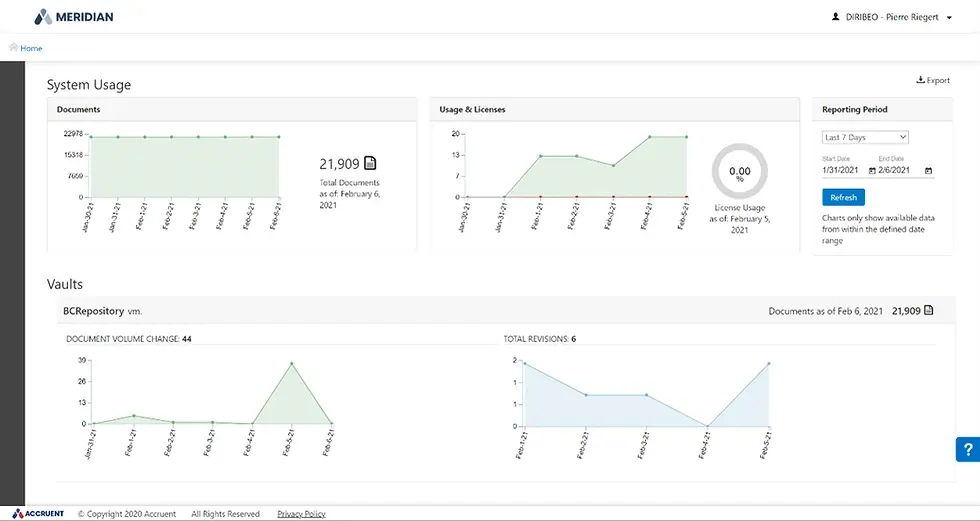
Above, usage statistics for a Meridian Cloud vault
Meridian Mobile facilitates maintenance operations by providing access to documents on the move, as close as possible to the facilities, even when offline using a tablet or smartphone regardless of the platform used (IOS, Android or Windows mobile).

Above: Annotations of a document on the iPhone
Technical aspects
Scalability – Scalability
Meridian Cloud uses the Microsoft Azure Cloud Computing services. Performance adapts dynamically to needs. Optimizations and compatibility with the latest technical and office applications are continuously maintained by automatic updates. New improvements are rolled out every quarter.
Security
Built on the Microsoft Azure platform, Meridian Cloud is based on security systems established by Microsoft, ISO 27001 certified.
Meridian Cloud extends the Azure platform with operations controls based on the most demanding practices including, but not limited to:
Principle of access to the least privilege
Role-based access controls-Data security
Staff security training
Regular audit
Penetration tests
Conclusion
The first version of Meridian Cloud appeared in 2017. Over the past three years, the publisher has developed its SAAS platform using a very different strategy from Meridian Server.
Over the years, Meridian Server has been enriched with functional capabilities in the form of toolkits capable of meeting all kinds of requirements and constraints.
The new features developed for Méridian Cloud offer a more rigid framework, less customizable, but focused on recognized standards and approved practices. This approach eliminates the risk of technical or technological deadlock and allows the system to evolve continuously and without regression.
The multiple advantages of the Cloud, acclaimed by the health crisis, tend to erase the constraints due to the functional rigidities of the tool.
Meridian Cloud thus becomes the default solution, the one we will evaluate first. The cases in which it will have to be ruled out (for the benefit of Meridian Server, for example) will become increasingly rare: These will most often be legal considerations where the Cloud is not an option, or specific functional constraints. for example when Meridian is one of the building blocks of a complex integrated data management solution: coupling with geographic data management systems (GIS) or with 3D construction modeling (BIM). However, it is a safe bet that these technical constraints will disappear in the coming years and that these technological couplings will also be carried out through cloud developments.
Meridian cloud is currently a generic solution aimed at any company with industrial or tertiary assets to manage. In the future, Meridian Cloud may well have different variations in order to offer environments tailored to the specific needs of certain areas of activity. In this context, there is already a version for the healthcare professions (Méridian Cloud for Life Sciences) that takes into account regulatory compliance issues. By adopting Meridian Cloud for Life Science, pharmaceutical companies have a certified environment that complies with the strictest standards (Ex: FDA CFR 21.Title 11).


