
Digital Twin: moving from the 3D model to operating value
Updated: May 7
The digital twin is now at the heart of digital transformation strategies in industry, construction and infrastructure. Yet, one reality persists: a 3D model alone is not enough.
Without the data associated with it, a digital twin remains a mere visual representation. Its true value lies elsewhere: in the continuity and exploitation of information.
BEYOND 3D: THE DATA AT THE HEART OF THE DIGITAL TWIN
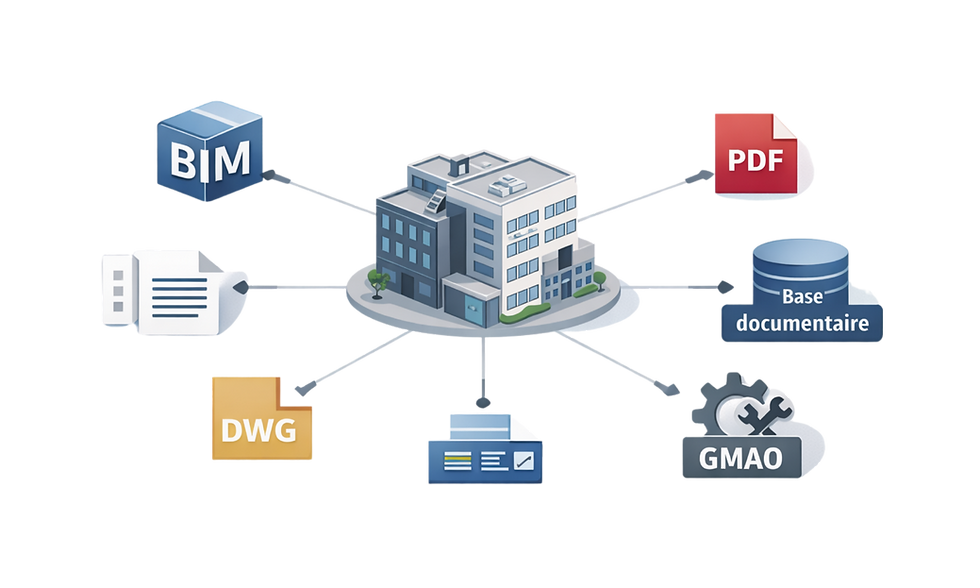
A powerful digital twin is not limited to a BIM model. It must integrate all the technical information necessary for the operation of the assets.
This involves in particular:
associate technical documents (PDF, DWG, procedures...) to the BIM objects
ensure the consistency of versions over time
structure information by asset
connect the documentation to the maintenance systems (GMAO)
This approach makes it possible to transform a static model into a dynamic tool, useful on a daily basis for teams.
A STRONG REQUIREMENT ON THE GROUND SIDE
The value of the digital twin is measured above all on the ground.
Operations and maintenance teams have simple but critical needs:
immediate access to information
reliable and up-to-date data
a possible consultation on the move
Without it, even the best models lose their operational usefulness. Information becomes difficult to use, interventions slow down and risks increase.
FROM PROJECT DATA TO MAINTENANCE PERFORMANCE
One of the major challenges is the transition between the project phase and the operation phase.
Too often, the data produced during design and construction is underused or lost. Yet they are an essential lever for improving maintenance.
By structuring and connecting this data from the start, companies can:
optimize maintenance interventions
reduce downtime
improve the safety of operations
to extend the lifespan of assets
The digital twin then becomes a real management tool.
A DIGITAL CONTINUITY TO BE GUARANTEED
Digital must not stop at the delivery of a project.
To create value, it must support the entire lifecycle of assets: design, construction, operation, maintenance, and evolution.
This continuity is based on:
rigorous document management
a constant update of the data
integration with business systems
It is under this condition that the digital twin becomes a strategic asset for the company.
MODELED... OR REALLY USABLE?
The question is no longer whether a digital twin is useful, but how to make it usable.
An impressive 3D model can be attractive, but without reliable and connected data, it remains limited. Conversely, a well-structured digital twin, integrated into business processes, becomes a powerful performance lever.
Is your wealth simply modeled... or really exploitable?


